

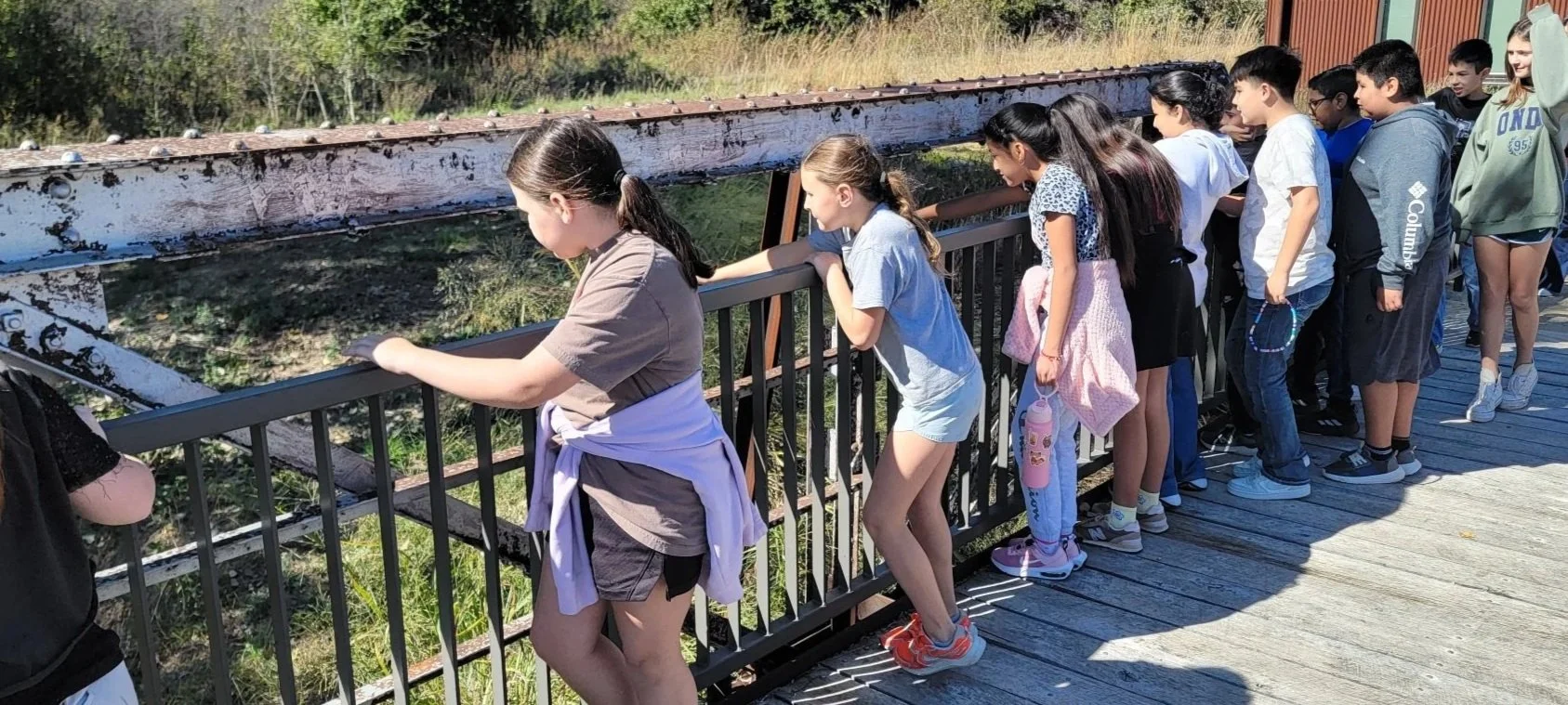
Bring Your Students to The Ditch
Education Programming with The Ditch
Multi-Level Programming
Our education programs serve learners from Pre-K through college, with content tailored to every age and ability.
Flexible Group Capacity
While our outdoor classroom seats 36 students, we can easily accommodate larger groups by rotating classes through different stations across The Ditch.
TEKS-Aligned Curriculum
All programs follow TEKS-aligned curricula that connect classroom learning with real-world water and environmental science.
Program Costs · Required Forms · Good to Know
Program Costs
All Ditch education programs are completely free to schools and groups.
There is no charge for instruction, materials, or access to our outdoor classroom and trails.
Teachers or group leaders are responsible for:
- Transportation (bus or personal vehicles)
- Snacks, lunches, or drinks for students (an onsite water fountain is available)
- Sunscreen and insect repellent application prior to arrival
- Any required medical or personal items for participating students
We’re committed to making outdoor learning accessible and affordable for all students.
Waiver
- Please ensure that parents submit either the online waiver or complete a printed waiver before your students visits The Ditch.
- A PDF copy as well as an online form are available below.
Good to Know
- We have bus drop-off and parking areas directly at The Ditch. Extra parking is available in front of the Middle Trinity office and across the street at the Art Briles Stadium for personal vehicles or overflow.
- We encourage parent and community helpers to join the learning experience.
- Closed-toed shoes strongly recommended. This helps keep students safe as they walk through natural areas and field stations.
- The Ditch has bathrooms and a water bottle refill/fountain available for students and staff.
- Our classroom is fully open-air; please dress appropriately for the day's weather (hot, cold, or muddy).
Explore The Ditch — Our Education Programs
Welcome teachers, homeschool families, and student-groups! At The Ditch, we offer a wide variety of environmental science and groundwater education programs, from Pre-K through college level, designed to connect learners with Texas nature in hands-on, place-based experiences.
Use the menu below to explore our program offerings: each entry expands to show details, skills, vocabulary, and cooresponding TEKS. Whether you’re planning a one-day field trip or an ongoing curriculum partnership, we’re here to help you bring your students outside.
March Program Options
(Theme: Weather + Nature)
-
What Students Will Do:
Students will create a rainstick using natural and recycled materials. They will explore how ancient cultures used instruments to imitate the sound of rain and discuss how sound relates to weather.Skills:
Gathering information, Organizing and analyzing, Applying knowledge, Creativity and construction, Presenting findings
Vocabulary:
rainstick, culture, percussion, instrument, musicologist, ceremonial, sound, vibrationTEKS:
1-2.5.A
2-4.8.A-B
3-5.1.A-C
-
What Students Will Do:
Students will compare weather and climate using real or historical data. They choose a vacation destination and design a visual marketing campaign explaining why the location is ideal based on weather patterns.Skills:
developing and using models, analyzing data, asking questions, mathematical reasoning, designing solutions, creativity & communicationVocabulary:
climate, climate change, climate normals, climatologist, historical average, meteorologist, precipitation, temperature, weatherTEKS:
3-5.1-2
3-5.10
8.10
-
What Students Will Do:
Students will learn what rain gardens are and how they help manage water and reduce flooding. They will explore the rain gardens at the Ditch, design a miniature rain garden, and test its effectiveness using simulated rainfall.Skills:
engineering design, modeling, testing, analyzing results, problem-solvingVocabulary:
storm garden, rain garden, runoff, infiltration, native plants, filtration, sustainability, erosionTEKS:
3-5.1
3-5.7.1
4-5.11.A-C
5.2.A
-
What Students Will Do:
Students will observe the sky and identify cloud types using a cloud chart. They will learn how clouds form, what different cloud types indicate about upcoming weather, and record sky observations in a weather log.Skills:
observing, classifying, predicting, recording data, using scientific toolsVocabulary:
clouds, cumulus, cirrus, stratus, cumulonimbus, condensation, evaporation, forecast, atmosphereTEKS:
K-2.10.A
3-5.10.A-C
-
What Students Will Do:
Students will build a simple anemometer using cups, straws, and a dowel. They will test it outdoors, measure wind speed, and compare readings before & after environmental changes (open space vs. sheltered area).Skills:
designing and building, measuring, analyzing, testing, interpreting dataVocabulary:
wind speed, anemometer, breeze, gust, measurement, air pressure, meter, rotationTEKS:
2.5.A
3.6.C
3.10.A-B
4.6.A
5.1-2
3-5.1.B
5.2.A
April Program Options
(Theme: Connections in Nature)
-
What Students Will Do:
Students act as water molecules moving through stations that represent parts of the water cycle (clouds, animals, soil, rivers, plants). They record their journey and reflect on how water connects all parts of nature.Skills:
modeling, sequencing, interpreting systems, critical thinking, communicationVocabulary:
evaporation, condensation, precipitation, transpiration, runoff, groundwater, cycle, reservoir -
Macro Mayhem (Aquatic Invertebrate Bioindicator Study)
What Students Will Do:
Students explore collected macroinvertebrate samples (real or model cards). They identify species and determine what the community says about water quality and ecosystem connections.Skills:
observation, classification, analyzing patterns, data interpretationVocabulary:
macroinvertebrate, ecosystem, indicator species, biodiversity, pollution tolerance, habitat -
What Students Will Do:
Using beads, cubes, or a pie chart model, students explore how Earth’s water is distributed across oceans, ice, groundwater, and freshwater sources. They analyze why freshwater is limited and how humans rely on interconnected systems.Skills:
modeling, calculating proportions, analyzing data, interpreting graphsVocabulary:
freshwater, groundwater, saltwater, distribution, reservoir, conservation -
What Students Will Do:
Students will analyze the results of a simulation to understand that water is a shared resource and is managed.Skills:
analyzing, problem solving, observingVocabulary:
conservation, water quality, finite resource, reusable resource, water quality, watershed
May Program Options
(Theme: Native Plants, Roots, and Water)
-
What Students Will Do:
Students investigate how plant roots locate and absorb water. Using a clear soil column or jar experiments, students observe root growth patterns and test how water moves through different soil types. They compare shallow vs. deep-rooted native plants.Skills:
observing, modeling, comparing, analyzing, conducting simple experimentsVocabulary:
root system, taproot, fibrous roots, absorption, capillary action, moisture, drought-adaptedSkills:
observation, classification, pattern recognition, comparing structures, communicationVocabulary:
native species, leaf margin, stem, flower, root system, habitat, adaptation, ecosystem -
What Students Will Do:
Students explore the Ditch to observe blooming native wildflowers at peak season. They study flower parts, pollinator interactions, and the role of rainfall and soil moisture in bloom timing. Students create a bloom chart to record species observed.Skills:
observation, classification, data collection, scientific drawing, pattern recognitionVocabulary:
wildflower, pollinator, nectar, bloom, petals, pistil, stamen, native species, seasonalitySkills:
observation, classification, analyzing structures, collecting data, comparing traitsVocabulary:
insect, arthropod, exoskeleton, thorax, abdomen, pollinator, predator, decomposer, life cycle -
What Students Will Do:
Students examine prairie species like big bluestem, switchgrass, rattlesnake master, and coneflowers. They study diagrams or root models to understand how deep roots store carbon, stabilize soil, and influence water infiltration. Students compare prairie roots to turfgrass.Skills:
model interpretation, analyzing systems, comparison, communicationVocabulary:
prairie, root depth, carbon storage, erosion, infiltration, resilience, perennialSkills:
observing, analyzing, testing, classification, recording dataVocabulary:
soil, humus, erosion, clay, sand, silt, organic matter, permeability, decomposition -
What Students Will Do:
Students role-play as pollinators, transferring “pollen” using pom-poms, cotton balls, or chalk dust. They simulate how native plants depend on insects and how water availability affects nectar production, bloom timing, and pollinator survival.Skills:
modeling, interpreting relationships, systems thinking, teamworkVocabulary:
pollination, pollinator, nectar, habitat, reproduction, ecosystem, dependence -
What Students Will Do:
Students investigate riparian zones (plant communities along water’s edge) and learn how these plants reduce erosion, filter pollution, and regulate water flow. Students model how roots stabilize riverbanks using trays of soil with and without plant cover.Skills:
investigating, modeling, analyzing cause & effect, interpreting dataVocabulary:
riparian, erosion, filtration, buffer zone, stabilization, sediment, runoff
-
What Students Will Do:
Students explore the Ditch to observe and identify native plant species using field guides or ID cards. They compare plant characteristics, learn plant adaptations, and participate in a plant ID memory or matching challenge.Skills:
observation, classification, pattern recognition, comparing structures, communicationVocabulary:
native species, leaf margin, stem, flower, root system, habitat, adaptation, ecosystem -
What Students Will Do:
Students search for insects around the Ditch using sweep nets, bug boxes, and observation tools. They identify insects by body parts and classification groups, and learn the ecological roles insects play in ecosystems.Skills:
observation, classification, analyzing structures, collecting data, comparing traitsVocabulary:
insect, arthropod, exoskeleton, thorax, abdomen, pollinator, predator, decomposer, life cycle -
What Students Will Do:
Students examine soil samples to identify components such as sand, clay, silt, organic matter, and living organisms. They test soil texture, permeability, and smell/feel, connecting soil to plant growth and the larger ecosystem.Skills:
observing, analyzing, testing, classification, recording dataVocabulary:
soil, humus, erosion, clay, sand, silt, organic matter, permeability, decomposition -
Local Wildlife Exploration (Urban Wildlife & Animal Evidence)
What Students Will Do:
Students learn about animals that live in urban and suburban habitats, including species found around the Ditch. They examine animal skulls (such as deer), animal tracks, scat models, and signs of wildlife activity to infer behaviors and adaptations.Skills:
inference, observation, comparing structures, interpreting evidence, critical thinkingVocabulary:
urban wildlife, habitat, mammal, track, scat, adaptation, predator, prey, niche -
What Students Will Do:
Students explore monarch migration, map their migration route, and learn how monarchs use environmental cues like temperature, daylight, and wind. They examine the monarch life cycle, body parts, and adaptations for survival. For hands-on engagement, students may create a migration model or examine milkweed plants.Skills:
modeling, mapping, sequencing, analyzing adaptations, interpreting patternsVocabulary:
migration, metamorphosis, chrysalis, larva, pupa, adult, pollinator, habitat, adaptation, generation, navigation -
What Students Will Do:
Students investigate why and how birds migrate by examining real migration maps, flyway routes, and species that pass through Texas. They explore the challenges migrating birds face: weather, habitat loss, predators, and energy needs. Students may participate in a migration simulation game, examine bird adaptations (wing shapes, beaks, feathers), and observe local birds if time/season allows.Skills:
mapping, interpreting patterns, modeling, analyzing environmental factors, observation, critical thinkingVocabulary:
migration, flyway, route, navigation, adaptation, stopover site, habitat, energy, migration triggers, seasonal change